April 22, 2026
Swarm Intelligence - A Brain Dump from a Late Night Rabbit Hole
I stumbled on MiroFish, and it sent me straight back to a third-year classroom where a professor drew ant trails on a whiteboard. This is just me thinking out loud about swarm intelligence.
Quick note before you start: This isn’t a tutorial. No code snippets, no step-by-step guides, no assignments at the end. This is just me thinking out loud after a late-night reading session. If you want a proper structured lesson on swarm intelligence, Google has you covered. If you’re here to read one engineer’s unfiltered thoughts on a topic that genuinely excites him, welcome.
I was reading about MiroFish last week. It’s a prediction engine that spawns thousands of AI agents, drops them into a simulated social world, and just watches what comes out of their interactions. No single agent knows the answer. The answer just… surfaces, from all of them together.
Something about that description cracked open a memory I hadn’t touched in years.
Third year. AI class. One professor, really into his subject. He drew ant trails on a whiteboard and said:
“The ant doesn’t know it’s building a city. It just follows the smell.”
I didn’t fully get it then. I do now.
The Ant Colony Thing - Let Me Actually Walk Through It
The professor’s whiteboard didn’t have animations, so let me give you the version that actually landed for me.
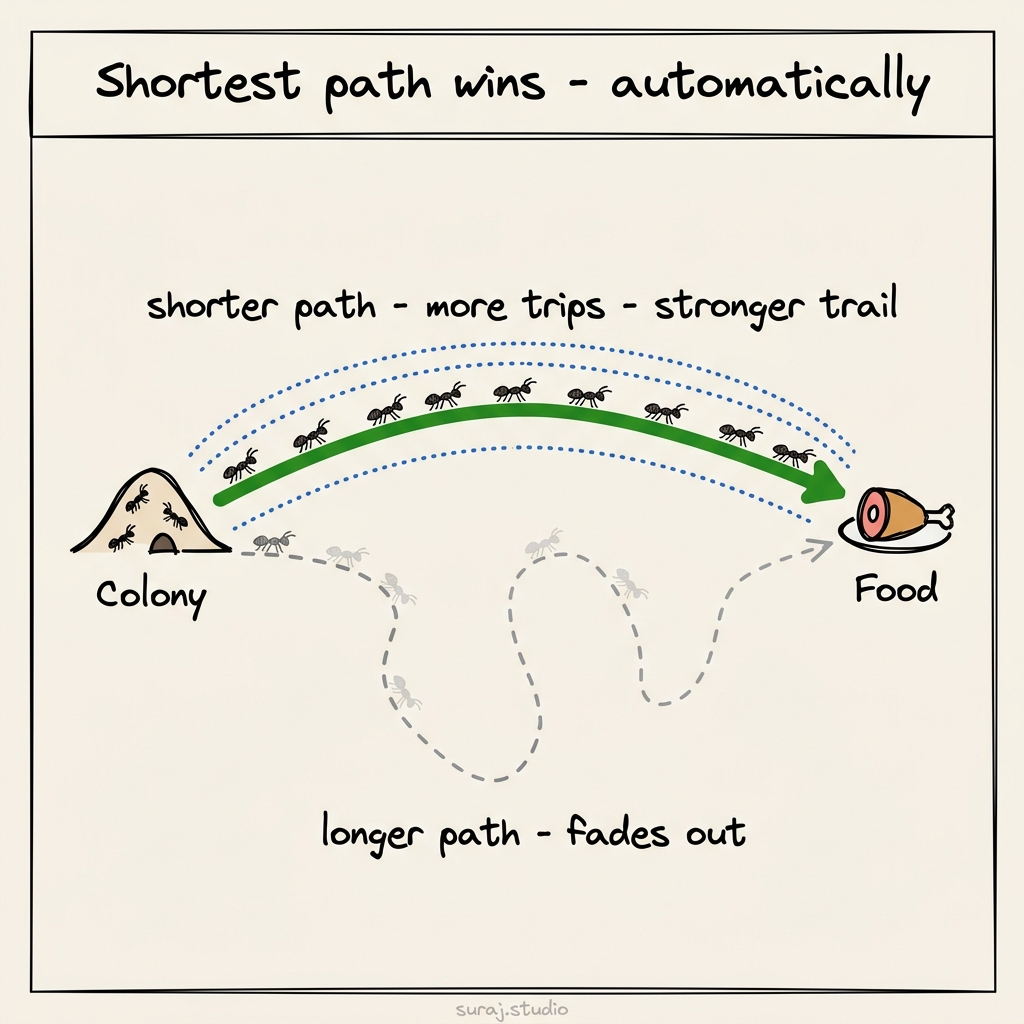
Imagine a colony of ants and a piece of food 50 meters away. The first ant to find it doesn’t know the shortest path. It just wanders. Eventually it gets there, picks up a crumb, and walks back, leaving a pheromone trail the whole way.
Other ants pick up that trail and follow it. Here’s the part that makes this work: the shorter the path, the faster an ant completes the round trip, the more times it reinforces that trail before the pheromone evaporates. Longer paths get reinforced less. Shorter paths get reinforced more. Over time, the whole colony converges on the shortest route. Not because any ant calculated it, but because the system naturally amplified the right signal and let the wrong ones fade.
No meeting. No Jira ticket. No manager approving the route.
Now block that path with a rock. Within minutes, the ants reroute. The old trail evaporates (pheromone is time-limited), new paths get explored, and a new shortest route emerges. The system self-healed and nobody restarted anything.
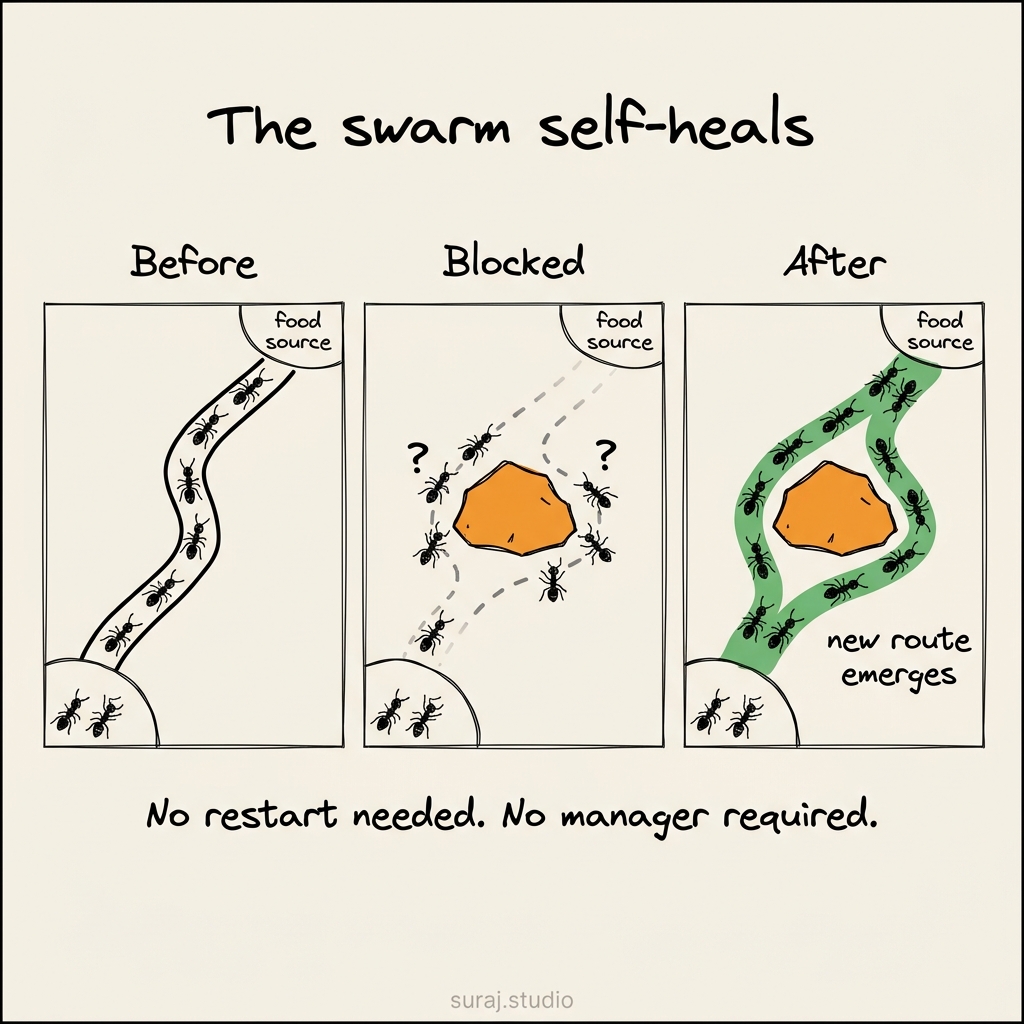
This is the thing that gets me every time. The intelligence isn’t stored in any individual ant. It’s spread across the colony’s behavior over time. The colony is smarter than the sum of it’s members.
MiroFish Made This Real for Me Again
When I read about MiroFish spawning thousands of AI agents, each with different personalities, memories, and social connections, and watching predictions emerge from their interactions, I immediately thought: this is the ant colony, but for forecasting human behavior.
No single agent knows what’ll happen if semiconductor tariffs double. But thousands of simulated humans, analysts, retail investors, supply chain managers, politicians, all interacting on simulated Twitter and Reddit? The answer surfaces from the noise.
Same principle. Different substrate.
And that’s what i find genuinely exciting about where AI is going. Not the giant single model that knows everything. The coordinated swarm of simpler agents that collectively figure it out. MiroFish is an early, real, working example of that.
The Part That’s Been Living Rent-Free in My Head
I keep thinking about what this means outside software. The ant colony isn’t a metaphor for distributed systems. Distributed systems are a metaphor for the ant colony. The real thing is older and stranger and more interesting.
Starling murmurations. Thousands of birds moving as one fluid shape in the sky, no leader, each bird just tracking its seven nearest neighbours. The shape is alive, and it’s made of nothing but local rules.
Fish schools that split around a predator and reform on the other side in under a second. No fish is coordinating that. It just emerges.
And I keep landing on the same thought: we’ve been trying to build intelligence with a brain. Nature’s been runing intelligence with a crowd for 500 million years.
Something I Want to Build (Eventually)
Here’s the ambitious, probably-will-take-me-years idea that’s been sitting in my notes.
A swarm of low-cost drones that work together to secure large agricultural land, farms, orchards, open properties, without any central controller. Each drone covers its zone. But when one detects movement or a threat, it doesn’t radio HQ. It emits a signal that the neighboring drones respond to, adjusting their patrol patterns, tightening coverage around the area of interest, forming a coordinated response. Kind of like antibodies clustering around an infection site.
If one drone’s battery dies or it malfunctions, the swarm redistributes. No single drone is critical. The security coverage is emergent, not assigned.
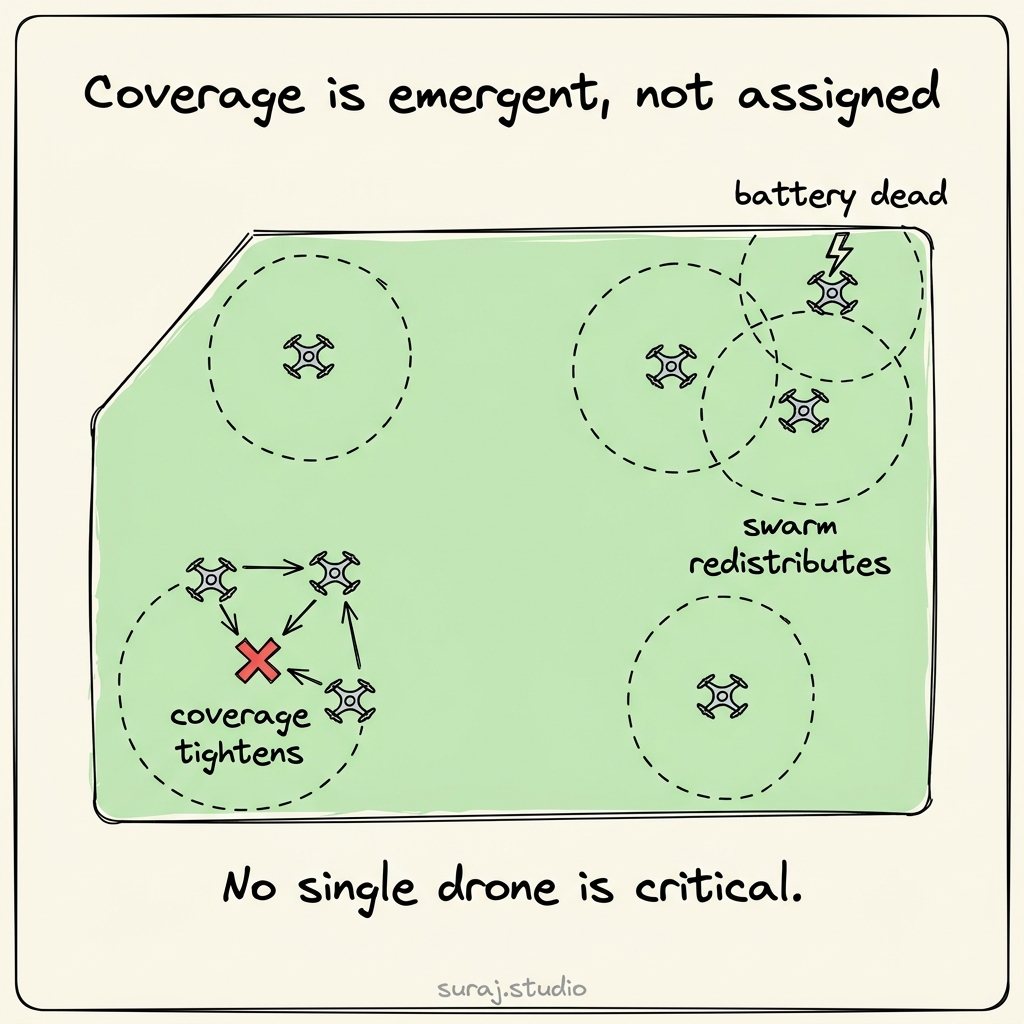
I don’t know when I’ll build this. But the core architecture is already clear in my head, and it looks exactly like an ant colony.
That’s It
MiroFish, memory of a professor, ant trails on a whiteboard, swarm intelligence, drones over farms.
That’s the chain of thought that kept me up till 2 AM last week.
I’m not sure where I’m going with all of this yet. But the idea that intelligence can be a property of a group and not an individual, that coordination can emerge from simple rules without a coordinator, feels like something worth paying attention to.
The ants have been running on this architecture for 130 million years. We’re just starting to figure out how to copy it.